
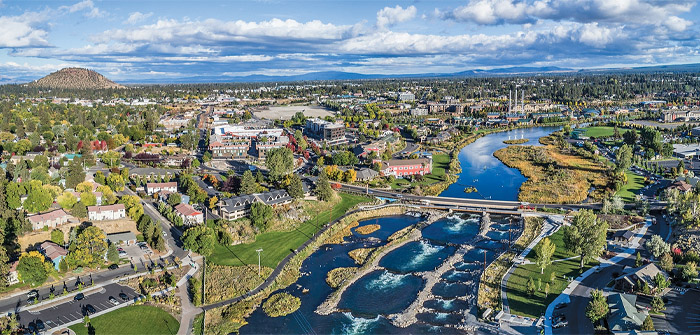
(Photo courtesy of Lightspeed Networks)
Do you know who owns your internet provider?
Most business owners don’t. They tend to think about ownership only after a provider is acquired, local support changes, or promised network investments fail to materialize. This matters because major broadband providers across the Pacific Northwest have been shifting hands lately, through transactions often decided far from the communities affected by them.
Lightspeed Networks has a different story. It started twenty years ago, right here in Central Oregon.
In 2005, no commercial carrier was willing to invest in fiber infrastructure across this region. Central Oregon simply didn’t pencil out on a national spreadsheet. The region was too rural, too spread out, and too far from the population density required to justify a conventional fiber build. The region couldn’t afford to wait for that math to change, so a handful of local organizations decided to change it themselves.
Five rural electric cooperatives and the Coquille Indian Tribe looked at that gap and made a decision most companies never have to make: build it themselves, or watch their communities fall further behind. They understood that reliable connectivity was essential to economic growth, education, and healthcare access.
So, they put up the capital, took on the risk, and built the network Central Oregon has relied on ever since. Lightspeed Networks exists because they refused to wait for permission. In the years since, that same commitment has extended service to schools, hospitals, and businesses in parts of the region larger providers have historically underserved.
The founders have since moved on but the legacy and culture that pioneered the network in central Oregon persists today, and every decision about investment, service, and growth gets made with Central Oregon’s best interests in mind.
Ownership Is the Difference
Every provider in this market is talking about speed and bandwidth right now. Almost none of them are talking about who owns the network behind those claims. And too few businesses are asking the questions that actually matter: Who picks up the phone when something breaks? Who reinvests in the network and the communities that depend on it? Who’s still going to be here in twenty years?
We do. Our network isn’t an asset waiting for the next ownership cycle. It was built to serve this region for the long term, and it remains accountable to the people who use it.
That’s why ownership should be part of every provider evaluation. It may not appear on a proposal, but it can shape what happens after the contract is signed. Business leaders should ask who owns the network, where investment decisions are made, who has authority during a service disruption, and what happens to service commitments if local operation changes.
Local accountability like this matters more than ever, because Central Oregon isn’t standing still. Redmond’s airport is mid-expansion, and Prineville keeps drawing interest as a data center hub. Growth like that needs a network partner making long-term infrastructure decisions with the region’s future in mind.
Lightspeed Networks is that partner for the clinic that can’t afford network downtime, the school district connecting classrooms across three counties, and the manufacturer moving data as fast as the region grows. When any of them calls with a problem, it’s answered by people who live here, send their kids to the same schools, and have a stake in whether Central Oregon keeps growing the right way.
Local operations also shorten the distance between a customer’s problem and the people empowered to solve it. For Bend Park and Recreation District, that meant finding a way to connect five recreation and office facilities within budget, despite several obstacles.
Central Oregon built its own network because the region couldn’t afford to wait. The people making decisions about the network’s future have a stake in the region’s future, too. That’s what local accountability looks like.