
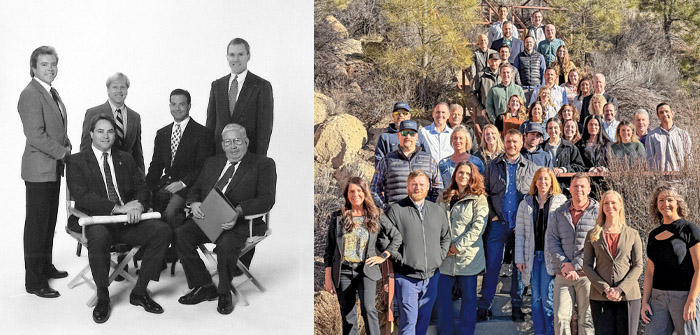
((Left) (L-R) 1996 Compass Commercial Team. Standing: Steve Toomey, Bill Pon and Erich Schultz. Sitting: Eric Nelson, Jeff Brock and Nick Amundson (Right) Today’s Compass Commercial Real Estate Services team gathered for a group photo in early 2026 | Photos courtesy Compass Commercial)
When Compass Commercial Real Estate Services was founded in Bend in 1996, leaders Erich Schultz and Steve Toomey saw something many had yet to fully recognize: Central Oregon was on the verge of significant growth.
At the time, the region’s commercial real estate market was relatively small and fragmented. Commercial property information was not readily available and many transactions were handled by residential agents or property managers. Despite those realities, Schultz and Toomey, along with their founding team, believed the area’s quality of life, economic potential and growing appeal to businesses and residents would drive long-term expansion.
“There were two commercial real estate brokerage companies and many residential brokers who took on commercial transactions,” recalled Schultz. “This was the extent of the professionals serving Deschutes County. The market and number of transactions were small.”
Thirty years later, Compass Commercial is celebrating a milestone anniversary as one of Deschutes County’s most established commercial real estate (CRE) firms, having played a role in many of the developments that helped shape Central Oregon.
The CRE landscape looked dramatically different than it does today.
When Compass Commercial launched, Bend’s office inventory consisted of just 84 buildings totaling approximately 840,000 square feet. The city’s industrial inventory totaled 125 buildings and 1.8 million square feet. In Redmond, the industrial market included only 19 buildings totaling roughly 320,000 square feet. Today, those figures have grown to approximately 225 office buildings and 2.8 million square feet of office space in Bend, along with 333 industrial buildings totaling more than 4.8 million square feet. Redmond’s industrial market has expanded to approximately 1.85 million square feet.
With prescience, Compass Commercial’s founders believed changes were coming.
“We thought that Central Oregon would grow,” said Schultz. “That’s not to say that we predicted the phenomenal growth that we’ve experienced. We had two strong beliefs. One, that people and companies would continue to move to Central Oregon. People were moving in from Portland, Seattle, San Francisco and LA and we thought this would continue well into the future.”
The second belief was equally important.
“Those relocating here were used to certain services and had standards for those services that they would bring with them from the larger markets they were leaving,” Schultz said. “Thus, we set out to create a full-service commercial real estate company that would meet the expectations and needs of these new arrivals.”
For Schultz, success came down to a straightforward philosophy.
“We were young and ambitious,” he said. “It was our opinion that if we pursued business aggressively and ethically, success would follow.”
Growing Alongside Central Oregon
Looking back at Central Oregon in 1996 offers a snapshot of a region that was only beginning to emerge as a major commercial market.
The first edition of Compass Points, the quarterly market report launched by Compass Commercial the same year the company was founded, documented a Bend that looked very different from today.
The report noted that the first phase of the Old Mill District’s retail component was still in the design stage. Cascade Village Shopping Center had just been unveiled. Home Depot and Waremart — now WinCo — were merely prospective tenants. Plans called for future retailers such as Barnes & Noble, OfficeMax, Taco Bell and Burger King to establish a presence in Bend.
The publication also highlighted a 100-acre property sale in northeast Bend that helped unlock future industrial development. Today, that former Brinson property is home to the city’s largest industrial submarket, comprising more than 2.4 million square feet.
Meanwhile, Redmond’s industrial future was beginning to take shape around the relocation of the Deschutes County Fairgrounds and the purchase of the former Crown Pacific mill site, which would later become a major driver of industrial growth in the city.
Compass Commercial was there from the beginning.
“When we launched the company, we had already established relationships with Brooks Resources and Bill Smith,” Schultz said. “Brooks was developing industrial lots in Shevlin Center and multifamily lots off of College Way and Shevlin Park Road. We were selected to assist with the marketing and sales of these parcels.”
The company also became involved in the early evolution of the Old Mill District.
“Bill Smith was on the front end of developing the Old Mill District,” Schultz said. “We assisted him with a feasibility study and later represented many land buyers and some tenants for whom he developed buildings.”
Over the years, Compass Commercial contributed to a wide range of projects that helped define Central Oregon’s commercial landscape.
“Mill Point Business Campus, Century Park, the Box Factory, Airport Business Center, 360 Bond, the commercial core of NorthWest Crossing are all projects we have been fortunate to have contributed to,” Schultz said.
Building a Team and a Reputation
While Bend’s skyline and commercial inventory expanded, Compass Commercial was focused on building a company culture designed to support long-term success.
According to Schultz, one of the company’s most important decisions involved the people it brought into the organization.
“Two things stand out,” Schultz said. “One, we were selective in the brokers, property managers and employees that we brought aboard. This resulted in very satisfying long-term engagements with talented individuals that coalesced into a productive team.”
The second differentiator was information.
Compass Points, the firm’s signature newsletter, became a vital contribution to the region’s commercial real estate industry.
“We produced the only commercial market newsletter in the region, Schultz said. “It was based on local data collected by our brokers. It wasn’t long before lenders, appraisers, developers, investors and tenants began to rely on these quarterly reports. This established us as the go-to firm in the area.”
Today, Compass Points remains one of the region’s most recognized sources of commercial real estate market data and analysis.
Internally, Compass Commercial intentionally fostered collaboration.
“From the beginning we made a conscious decision to design an office layout focused on spacious cubicles, rather than private offices,” Toomey said. “The layout was instrumental in creating a collaborative team culture where information and experience was shared freely and enthusiastically.”
The approach encouraged teamwork rather than competition.
“Because the commercial real estate market is so diverse, it is difficult to be an expert in every area,” Toomey said. “In the collaborative culture, it became normal for brokers to partner on transactions requiring specific expertise brought by another broker.”
The firm’s commitment to education also became a cornerstone of its growth.
“We definitely invest in our team members and encourage advancement in education for brokers and property managers,” said Ellisse Dickey, vice president, partner and marketing director.
Today, Compass Commercial’s brokerage team consists of 19 brokers, including eight who have earned the Certified Commercial Investment Member (CCIM) designation and three who have also obtained the Society of Industrial and Office Realtors (SIOR) credential. The property management division holds Accredited Management Organization (AMO) status and includes three Certified Property Managers (CPM).
“A dedicated marketing department and brokerage support team have also been instrumental to the company’s success,” Dickey said. “By allowing brokers to focus on relationship-building and deal execution, while a team of professionals handles marketing and operational support behind the scenes, Compass Commercial is able to meet the growing demands of the area’s commercial market.”
Expanding Services and Impact
Over the past three decades, Compass Commercial has evolved beyond traditional brokerage.
The company now provides brokerage, property management and construction services under one roof, a model leaders say creates efficiencies and better outcomes for clients.
Asked about the greatest benefit of the integrated approach, Toomey observed: “Having the services under one roof gives us the opportunity to better control quality, access and confidence in each service on behalf of our clients.”
The construction division emerged in response to market conditions.
“The Construction division was born as a response to an overheated market when it was difficult to find contractors to bid and perform smaller leasehold improvements in a timely manner,” Toomey said. “Bringing it in house gave our clients higher priority and our brokers more control.”
The company’s integrated approach has been particularly evident in several landmark projects.
Among them is The Quad at Skyline Ridge, formerly the Bend Bulletin building.
“We helped navigate the transition of the iconic Bend Bulletin building into the now Class A office/flex complex it has been beautifully transformed into today,” Dickey said.
Compass Commercial has also played a long-standing role in Juniper Ridge.
“We partnered with the City of Bend on that project for many years and are actively involved in the current sales and leasing efforts of the approximately 200 acres that are available for commercial and industrial development in Juniper Ridge,” Dickey said.
Dickey points to The Box Factory as perhaps the clearest example of the firm’s full-service capabilities.
“When Killian Pacific acquired The Box Factory in 2013 it was 35% vacant with significant deferred maintenance,” Dickey said. “Compass Commercial was tasked with re-tenanting the vacant spaces and repositioning the property in the marketplace.”
The results transformed the property into one of Bend’s most recognizable mixed-use destinations.
“The property is now fully redeveloped and has become an iconic mixed-use project in the heart of Bend,” Dickey said. “Compass Commercial handles the leasing and the property management of this building. Our construction division has also built out several of the spaces, making this property one that has showcased Compass Commercial’s full range of services.”
Looking Ahead
As Central Oregon continues to grow, Compass Commercial leaders see both opportunities and challenges ahead. Technology has fundamentally changed how real estate professionals operate, contributing to efficiency gains.
“Technology has certainly made our jobs easier, especially as it pertains to obtaining and disseminating information,” Toomey said. “It also seems to have depersonalized communications and relationships.”
Artificial intelligence platforms, both in general and specific to CRE, represent the latest shift.
“It is definitely a challenge navigating the technology growth,” Dickey said. “AI in particular has been exciting, helpful and, at times, a little daunting.” Still, she sees opportunity.
“We see AI as a way to streamline the way we do business by eliminating more routine tasks, allowing our team members to focus on higher-value work and the bigger picture items,” Dickey said.
Looking toward the next decade, the company plans to continue building on the same model that fueled its long-term success in Central Oregon.
“Compass Commercial was built on a foundation that sets it apart in an integrated model where brokerage, property management and construction aren’t just separate services but complementary strengths,” Partner and Vice President of Property Management Russ Monroe said. “Our role now is to expand that approach thoughtfully to new markets and clients.”
Today, the company oversees more than 4.4 million square feet across Oregon and Washington while maintaining a deliberate growth strategy.
For Monroe, the vision for the future remains rooted in local ownership and long-term commitment.
“In 30 years, Compass will still be locally grounded and owner-led,” he said. “That’s important to our clients. They’re not dealing with a national platform that sees their portfolio as just another line item. They’re working with partners who are part of these communities, understand the nuances of these markets and are committed to making the right decisions for the long term.”
Three decades after opening its doors, Compass Commercial’s story is inseparable from the story of Central Oregon’s real estate growth. As the region evolved, the company grew alongside it, helping shape commercial projects and providing market insight every step of the way.