

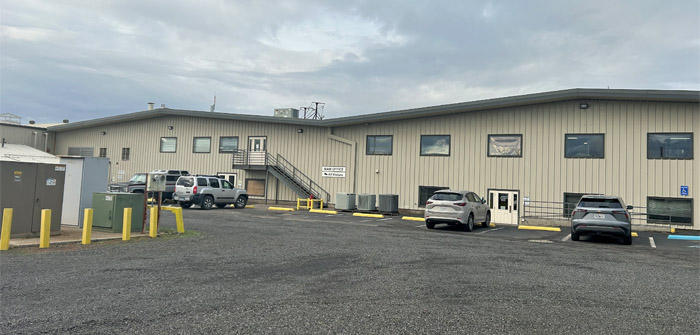
(Lexington Manufacturing acquired the former Owens Corning mill property in Prineville as part of its growing national footprint | Photos courtesy of Lexington Manufacturing)
When Owens Corning announced the closure of its Prineville mill operation last year, the news created uncertainty around one of the region’s most recognizable wood products facilities and dozens of workers tied to it. With the site’s late 2025 acquisition by Lexington Manufacturing, community leaders and company executives say the project represents more than a business expansion. It is an opportunity to preserve jobs, maintain a longstanding manufacturing legacy and strengthen Prineville’s economic future.
Lexington Manufacturing, a family-owned supplier serving the fenestration and architectural door industries, acquired the former Owens Corning mill property in Prineville as part of its growing national footprint. The facility includes roughly 600,000 square feet of manufacturing space and extensive production equipment, giving the company a major operational presence in Central Oregon.
According to Mike Dillon, president of Lexington Manufacturing, the company’s initial interest in Prineville was not centered on purchasing an entire facility.
“We were originally looking at some of the equipment that was being prepared to be auctioned by Owens Corning as part of their shutdown,” Dillon said. “When we visited, we realized very quickly that there was a much bigger opportunity to utilize the facility, the people and equipment as they existed in the current location.”
Rather than seeing the operation dismantled piece by piece, Dillon said Lexington leaders recognized value in keeping the facility functioning as a whole.
“Piecing the operation out in an auction did not seem to be the best use of the assets there,” he said. “More importantly, there was a core group of people remaining that would be the nucleus to get it started again.”
That workforce became a major factor in Lexington’s decision to move forward.
“We approached our ownership with the compelling story of what we thought restarting the operation could look like, and they got on board immediately,”
Dillon said.
For Prineville, the announcement arrives at a significant moment. While the community has diversified economically over the past decade through growth in sectors including data centers and advanced industries, wood products manufacturing remains deeply tied to the city’s identity and workforce.
“This community has a storied history in the timber industry,” said Josh Smith, planning director for the City of Prineville. “While not a raw cut mill, it is the last of the large wood product facilities.”
Smith noted that while the closure was not catastrophic to the broader regional economy, it had a substantial impact for employees connected to the site.
“The City has diversified its employment base over the last decade, so the closure was not a death blow to the community that it may have been in the past; however, it was to those employed there,” Smith said. “The facility provided up to 185 jobs for individuals with skill sets not easily transferred to other sectors.”
Lexington officials say restoring those opportunities is central to the company’s plans. Dillon said the company has already rehired or retained approximately 70 positions and expects employment to continue growing.
“Our plans over the coming couple of years call for at least 150 positions in total,” Dillon shared.
In addition to production roles, Lexington expects to bring additional support and administrative jobs to the facility.
“Several of the support positions that were previously located out of state will be hired locally as well,” Dillon said. “These are critical as they will support the business locally and will be focused on that location while living in the community.”
The company also anticipates sourcing many operational services and supplies from local businesses, creating additional indirect economic benefits throughout Central Oregon.
“We have not calculated the dollar impact but the indirect impact of having the site potentially be vacant to being operated and staffed will be beneficial in many ways,” Dillon said.
For Lexington, the Prineville operation fits into a broader strategy of expanding both geographically and operationally. Dillon said the company had long been familiar with the former Contact Industries business that once operated at the site.
“The original Contact Industries business was well known to Lexington,” he said. “They previously had been both a valued supplier and a competitor in the fenestration markets we serve.”
The location, he said, gives the company expanded production capacity while improving service to customers throughout the western United States.
“The Prineville location adds significant capacity and capabilities that complement our existing operations in Minnesota and elsewhere,” Dillon said. “Additionally, it extends our geographic reach to better serve customers on the West Coast.”
The facility will also strengthen Lexington’s manufacturing supply chain by increasing vertical integration.
“In addition to the significant expansion of capacity, the operation will allow us to be more vertically integrated in our current supply chain,” Dillon said. “The addition of the facility will greatly enhance our ability to pro duce solid pine millwork components as well as our veneer capabilities.”
For both city leaders and company executives, preserving the site’s role within the community remains a major focus.
“The history and pride for that operation in the Prineville community is an important part of that equation,” Dillon said. “We take our role in the community seriously and plan to be involved to do what we can to keep Prineville thriving.”
Smith emphasized the importance of keeping the large industrial site active rather than allowing it to sit vacant.
“With Lexington reviving this site, we are not only reclaiming vital jobs but also securing the facility’s long-term utility as a cornerstone of our economic diversification strategy,” he said.