

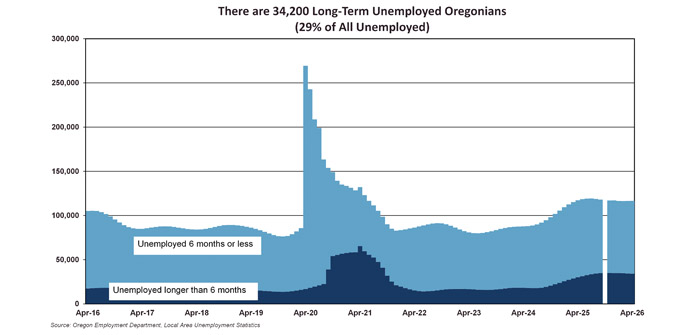
(Graph courtesy of Oregon Employment Department)
Since mid‑2023, the Bend MSA’s seasonally adjusted unemployment rate has been increasing, rising from a low of 3.7% in May 2023 to 5.0% in November 2025. Yet this upward trend has been gradual. For instance, in 2024 the rate didn’t change much, moving only slightly between 4.2% and 4.3% in June and holding around that range for the rest of the year. The pace picked up somewhat in June 2025, with the rate reaching 5.0% by November 2025, where it hovered until February 2026. Since then, the unemployment rate in the Bend MSA has edged down to 4.9% and has remained there.
While the recent movements in the unemployment rate help frame the short‑term trend, it’s also important to consider how these levels compare historically and what’s happening in the broader labor force. Even though the Bend MSA has not seen a seasonally adjusted unemployment rate of 5.0% since 2016, setting aside the COVID‑19 pandemic recession, 5.0% is still comparatively low. Additionally, while the civilian labor force in Bend MSA has decreased somewhat, this short-run trend is not uncommon within a normal business cycle. At present, this still suggests cyclical short-term losses rather than a long-term structural decline. That said, slightly more people are stepping out of the labor force altogether – many to retire – rather than continuing to look for work or move between jobs.
Long‑term unemployment has increased in Oregon, with one out of every three unemployed individuals jobless for six months or longer. At 29%, the share of long‑term unemployed is higher than at any point in the past decade, aside from the COVID‑19 period. These individuals are still applying for jobs, but they simply are not finding a suitable job placement. It’s reasonable to expect that some may become discouraged and leave the labor force altogether. Although this may not be the exact situation in the Bend MSA, the labor force is showing signs of weakening, as labor force supply has slowed and, more recently, even declined.
On the demand side, total private employment serves as a gauge of business sentiment and gives us insight into hiring patterns within the MSA. We typically see employment growth when business sentiment is strong and businesses increase hiring, which makes the local economy feel strong. The inverse is also true. When uncertainty or economic contraction begins to take hold, businesses pause hiring or begin to let workers go.
In the first quarter of this year, average total private employment posted year‑over‑year gains (+230 jobs). April was the first month in which the MSA saw a year‑over‑year decline (-560 jobs) according to preliminary estimates. What this tells us is that businesses have continued to hire and grow up until very recently. When second-quarter data is released, we will see whether the decline experienced in April carries into future months.
This private sector employment growth, as is the case most of the time, has been uneven: while some industries have fared well and continue to expand, others have contracted. Workers in those shrinking sectors may struggle to reenter the labor force as demand decreases. Competition within the growing industries may also have intensified, making it harder for job seekers to secure positions. Still, it’s difficult to know for certain, as many variables are at play.
| General Trend | ||
| Declining | Flattening | Increasing |
| Trade, transportation, and utilities Financial activities Information
|
Manufacturing
Leisure and hospitality Mining, logging Professional and
|
Private education and health services Other services
|
What we do know is that private health care and social assistance showed the strongest and most consistent growth in recent years and is responsible for much of the long‑term private‑sector expansion the area has experienced, but growth in this sector is also slowing.
Several industries that expanded earlier in the decade have now slowed or paused their hiring, which has resulted in limited movement and a broader flattening pattern. This includes manufacturing; mining, logging, and construction; leisure and hospitality; and professional and business services. Beyond these slowing sectors, industries trending downward include trade, transportation, and utilities; financial activities; and information.
Looking at the past year, other services and mining, logging, and construction also added jobs. However, most industries are either leveling off or beginning to decline, resulting in a net loss of 560 total private jobs in April. So, while employers have still been cautiously hiring, the labor force has begun to flatten out and the early signs point to a labor market that is losing momentum but not yet entering a downturn.